
Menu
Union City Concrete Repair: Knowing When Patching Isn’t Enough
Concrete Repair Union City
Protecting Union City property owners from costly structural failures and unsafe situations is why it is so important to understand how simple patching fails and when a more involved concrete repair must take place. When you have minor surface cracks and small damaged areas, most of the time you will be able to fix them with patching compounds and sealants; however, when there are large amounts of damage that need to be repaired, it will require a more involved approach than simply repairing the damaged area, it will require an approach that identifies the root cause(s) of the damage and repairs the structure itself. The urban setting of Union City, combined with its extreme weather conditions and the fact that many of its structures were built over 50 years ago, presents unique challenges for both the residents and business owners who live and work here in terms of their ability to perform simple repairs on their own. To ensure that they are investing in the correct repair method to provide them with a long-term benefit, homeowners and businesses must recognize the distinction between cosmetic repairs and structural repairs. A professional evaluation will help determine if the homeowner/business needs to repair the damaged area through patching or if he/she will need to take a more aggressive repair approach in order to prevent a catastrophic failure of the structure and/or expensive replacement costs.
Factors Limiting the Usefulness of Minor Patch Repair Techniques
Minor patch repairs are effective for repairing small surface damages (spalls), fine cracks, and localized defects that do not affect the structural strength of a concrete slab. However, if the underlying issue continues to damage the slab continuously, then minor patch repairs will eventually fail. In addition, minor patch repairs cannot restore structural integrity (load-bearing capability) to heavily damaged concrete nor address settlement-related problems in all portions of the slab. Freeze/thaw cycles in Union City can result in failures in the patch material due to poor bonding of the patch to the surrounding concrete and/or inadequate flexibility in the patch to allow for thermal expansion and contraction. Moreover, repeated applications of minor patch repairs to correct the same defect often result in higher costs than addressing the problem comprehensively at one time.
The Limitations of Continued Minor Patch Repairs as Compared to More Comprehensive Repair Approaches
Continued application of minor patch repairs indicates serious underlying structural problems that should be addressed with major concrete repair interventions rather than ongoing surface repairs. Extensive patch repairs typically indicate widespread structural issues in the slab and, as such, are generally incapable of being resolved by applying additional surface treatments alone. Poor bonding of patch materials to existing concrete creates weak links where water intrusion can accelerate deterioration. Union City’s high vibration levels generated by traffic and construction activities can cause inadequately bonded patches to delaminate, resulting in tripping hazards and exposing underlying damage. Furthermore, excessive patch repairs create uneven, aesthetically displeasing surfaces that reduce property value while providing no long-term structural solution.
Examples of Structural Damage That Require Major Repair Interventions
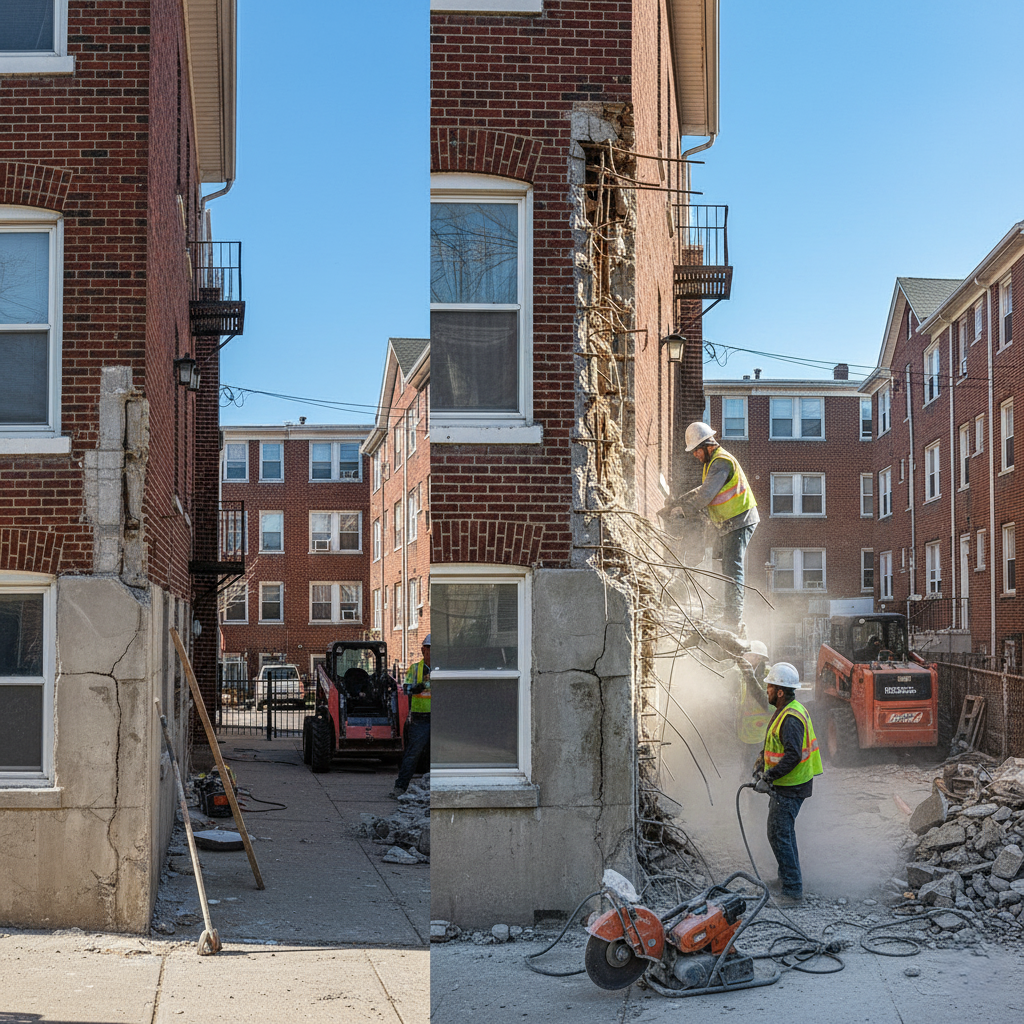
Horizontal cracks extending into the thickness of foundation walls indicate serious structural problems that require immediate major concrete repair rather than surface patching. Damage affecting multiple areas of a structure caused by settlement necessitates comprehensive stabilization and repair techniques to restore overall structural integrity. Spalling concrete that exposes reinforcing steel requires professional intervention to prevent corrosion and further weakening. Structural elements identified as load-bearing that exhibit signs of distress cannot be safely repaired with simple patching without a thorough structural analysis and engineered repair solutions. Commercial and residential buildings in Union City experiencing these symptoms should be professionally evaluated to determine the most appropriate major repair strategy.
Foundation and Load-Bearing Issues
Damage to a building’s foundation, evidenced by multiple symptoms throughout the structure, indicates the need for comprehensive concrete repair rather than isolated patch efforts. Differential settlement creates stress concentrations that require underpinning, stabilization, and repair of affected concrete components. Columns, beams, and load-bearing walls exhibiting distress require engineered repair solutions to restore original design capacity and prevent progressive failure. Water infiltration through foundation cracks, combined with structural movement, necessitates an integrated waterproofing and structural repair approach. Professional structural engineers evaluate these conditions to develop solutions addressing immediate safety concerns and long-term performance expectations.
Extensive Surface Degradation
When widespread spalling, scaling, and surface erosion occur over large concrete areas, resurfacing or overlay systems are preferred over individual patch repairs. Chemical attack from deicing salts or environmental exposure can cause damage exceeding the capabilities of patching materials. Interconnected crack patterns indicate structural stress and require comprehensive repair solutions. Due to Union City’s extreme cold temperatures, freeze/thaw cycles can damage entire slabs, making selective patching ineffective and temporary. Professional evaluation determines whether resurfacing, structural overlays, or replacement provides the most cost-effective long-term solution.
Patterns of Climate-Related Deterioration
Seasonal temperature fluctuations in New Jersey create expansion and contraction stresses that lead to concrete deterioration requiring major repair intervention. Freeze/thaw cycles repeatedly compromise concrete integrity over large areas, limiting the effectiveness of patch repairs. Water infiltration followed by freezing creates internal pressures that cause cracking and spalling. Deicing salts commonly used in Union City accelerate surface deterioration and reinforcement corrosion, requiring comprehensive repair strategies. Professional concrete repair addresses climate-related issues through proper materials, improved drainage, and protective systems to prevent recurring damage.
Drainage and Water-Related Problems
Persistent water infiltration and chronic concrete deterioration require major repair approaches that address both structural damage and water management. Poor drainage around foundations creates hydrostatic pressure and saturated soils beyond the capacity of simple crack sealing methods. Basement wall bowing caused by water pressure requires structural stabilization and comprehensive waterproofing. Union City’s urban stormwater challenges can lead to prolonged moisture exposure that accelerates concrete deterioration beyond patch repair limitations. Major repair projects combining structural repair, drainage improvements, waterproof membranes, and protective coatings provide effective long-term solutions.
Comprehensive Repair Solutions
Major concrete repair projects often involve addressing multiple interrelated issues that cannot be treated individually. Structural repairs combined with waterproofing, drainage improvements, and protective coatings provide comprehensive solutions that reduce the likelihood of recurring problems. Professional contractors develop systematic repair plans prioritizing structural concerns while incorporating preventive measures. Quality major repairs include proper surface preparation, compatible materials, adequate curing, and post-construction maintenance programs to extend service life. Although these approaches are more costly than repeated patching, they provide superior long-term value.
Safety and Compliance with Building Codes
Structural concrete damage posing public safety risks requires immediate major repair compliant with building codes and safety standards. Trip hazards, falling concrete, and reduced load-bearing capacity demand professional repair solutions that restore safe conditions. Union City building officials may require engineer-developed repair plans for significant structural damage beyond the scope of patch repairs. Professional repairs include permitting, inspections, and documentation to ensure code compliance. Property owners facing safety-related structural damage are subject to liability and should engage qualified professionals for major repairs.
Assessment and Development of a Repair Plan
Determining when major concrete repair is required involves professional evaluation of structural damage extent, safety risks, and long-term performance expectations. Experienced contractors assess damage patterns, identify underlying causes, and select permanent repair techniques rather than temporary fixes. Structural engineers may be required to evaluate load-bearing capacity and design repair systems restoring original performance. Professional repair planning includes material selection, construction sequencing, quality control, and post-construction maintenance recommendations. Union City Concrete Works provides a full range of concrete repair services, from minor patching to major structural rehabilitation, allowing property owners to select cost-effective, long-lasting solutions that protect their investment.