
Menu
Best Practices for Commercial Concrete Flatwork in Union City, NJ
Commercial Concrete Union City
Commercial concrete flatwork in Union City is subject to a variety of high-quality specifications and local building code regulations to provide long-lasting, functional surfaces for all businesses within Hudson County. Because it is a densely populated commercial area with a direct access route to New York, the commercial concrete work in Union City has an increased demand for durable concrete work as well as the ability to withstand extreme weather conditions, heavy traffic, and excessive usage. Contractors will have to comply with the New Jersey Uniform Construction Code when they deliver cost-effective solutions to fit the tight schedule of each project. By understanding what some of the best practices involved in this process are, property management professionals, developers, and business owners can be better informed regarding making smart decisions on their investment in their concrete flatwork. In addition to being able to provide the proper functionality immediately after completion, properly executed commercial concrete flatwork provides long-term protection to the value of the property in the competitive market of Union City.
Site Assessment and Preparation Standards
Beginning with the process of preparing a commercial concrete flatwork project, it is essential to have a professional evaluation and assessment of the soil prior to any work being done in Union City, NJ. A thorough evaluation will assess the bearing capacity of the soil, as well as its ability to drain water and potentially settle. Properties located close to the Hudson River may experience issues such as high water tables or soft soils, which may need special preparation.
The typical amount of excavation for commercial projects usually involves removing 8–10 inches of the top layer of material to allow the contractor to prepare a solid base and pour the necessary thickness of concrete. The excavated area must also be graded uniformly and sloped to prevent water from accumulating under the finished slab. Laser-guided equipment is used to accurately measure and grade the area to meet the project specifications.
After the subgrade has been prepared, the next step would be to compact the soil to the correct density (typically 95% of the standard Proctor density) to support the weight of the concrete slab. Soils that are unstable or have low bearing capacity may require stabilization using chemical treatment, replacing the soil, or geogrid reinforcement. Testing must be performed to ensure that the subgrade is capable of supporting the loads that the concrete slab will be subjected to.
The base course consists of four to six inches of compacted crushed stone aggregate in layers to achieve maximum density. The gradation of the aggregate must meet the New Jersey Department of Transportation (NJDOT) specifications to ensure that it can perform adequately in terms of both stability and drainage. By properly compacting the aggregate, voids will be eliminated and prevent the possibility of future settling or cracking in the concrete slab.
To prevent conflicts between the concrete placement and the existing utilities, the contractor should coordinate with the owners and/or facility managers to locate and verify the presence of utilities through New Jersey 811 services. Once these conflicts have been identified, any utility modifications that are required must be completed before commencing the concrete work to prevent possible delays to the project and additional costs.
Environmental and Regulatory Compliance
Prior to beginning the construction of a commercial project in Union City, the contractor must take into account the local environmental regulations and obtain any necessary permits. For example, if the project will result in over 5,000 square feet of disturbed surface area, an erosion control plan must be developed and implemented. Stormwater management plans must be created and followed to prevent sediment from entering the waterways during the construction process. In addition, dust control measures must be put in place to minimize the effects of dust emissions during the construction process to prevent potential harm to nearby businesses and to comply with local air quality standards.
Concrete Mix Design and Quality Control
Commercial concrete mix designs must be specifically designed to meet the performance criteria of the intended use, including strength, durability, and workability. Due to the varying climates present in Union City, the mix design must be able to withstand the potential freeze/thaw cycles while maintaining a sufficient working time for the contractor to successfully place and finish the concrete. The contractor must be able to develop project-specific mix designs in conjunction with a certified ready-mix supplier.
Compressive strength requirements vary depending on the specific use of the concrete, but are generally in the range of 3,000–4,000 psi for general commercial flatwork. However, heavier-use applications, such as loading docks or equipment pads, may require higher strengths and more extensive reinforcement. The mix design must provide the required strength while maintaining sufficient workability for the contractor to place and finish the concrete. The addition of 4–7% air entrainment will enhance the resistance to freeze/thaw damage caused by the varying climate.
Testing of the mix design begins with laboratory testing to verify the design specifications before the project commences. During the construction phase, the contractor will conduct various types of field testing, including slump tests to verify consistency and workability, air content measurements, and compressive strength specimens taken in accordance with ASTM standards. All testing results must be documented and maintained for quality assurance and warranty purposes.
Admixtures are added to the concrete mix to enhance the performance of the concrete for specific applications and environmental conditions. Water-reducing admixtures improve the workability of the concrete while maintaining strength, while accelerating admixtures enable the contractor to achieve the required strength levels in cooler temperatures. Corrosion-inhibiting admixtures protect the reinforcing steel in harsh environments.
Delivery Scheduling
Scheduling the delivery of ready-mix concrete is crucial to maintain an uninterrupted flow of materials to the job site, thereby minimizing the possibility of cold joints and lost productivity due to a lack of material. It is essential to establish a communication system between the contractor and the ready-mix supplier to prevent delays in placing the concrete and to maintain the quality of the placed concrete.
Material Certifications and Documentation
All commercial projects require certification documentation of the materials used in the project to ensure that the materials comply with the project specifications and industry standards. The contractor must maintain certified mill test reports for all materials used in the project, including the admixtures, and must document all testing results for the duration of the project. These documents serve as proof of compliance with project requirements and industry standards and will be required to support warranty claims and future maintenance planning.
Reinforcement and Structural Requirements
For most commercial concrete flatwork applications, the concrete must be reinforced to resist the stresses generated by the anticipated loads and the thermal movements of the concrete. The type and quantity of reinforcement used will depend on the expected loads, the thickness of the concrete, and the joint spacing. Welded wire mesh or rebar grids provide tensile strength to the concrete, since the concrete itself does not possess this strength.
The reinforcement design must follow the engineering specifications for the size, spacing, and concrete cover of the reinforcement. Standard commercial slabs are typically reinforced with #4 or #5 rebar in 18-inch to 24-inch spacings, positioned in the middle third of the concrete slab cross-section. Proper support systems must be installed to maintain the positioning of the reinforcement during the placement of the concrete.
In some cases, welded wire mesh may be used to reinforce lighter-duty applications where the use of rebar would be excessive. The mesh must be positioned correctly in the slab cross-section and must lap in accordance with the specifications to provide continuous reinforcement. Chairs or other support systems must be installed to prevent the mesh from shifting during the placement of the concrete.
Synthetic or steel fibers may be added to the concrete mix to provide additional crack control and improve the resistance of the concrete to impact and abrasion. Fibers supplement the traditional reinforcement provided by rebar or mesh and provide improved surface durability. The dosage rate of the fibers will depend on the specific application requirements and the desired performance characteristics of the concrete.
Construction Joints
Transfer devices, such as dowel bars, must be installed at the construction joints to ensure structural integrity and continuity of the slabs. Dowel bars transfer the loads from one slab segment to another while allowing for the horizontal movement of the slabs resulting from thermal expansion. The dowel bars must be precisely aligned and embedded in the concrete to a sufficient depth to prevent corrosion and ensure continued structural performance.
Heavy Duty Applications
Loading docks, equipment pads, and other high-traffic areas require increased reinforcement and thicker concrete sections to support the expected concentrated loads. Depending on the specific application requirements, the contractor may need to develop a custom mix design with a higher-strength concrete and additional reinforcement. Engineering calculations must be performed to ensure that the design will satisfy the expected loads and usage patterns.
Placement and Finishing Techniques
A commercial concrete placement begins with the installation of proper formwork to produce a smooth surface and the accurate elevations and edges required for the project. The formwork must be stiff enough to withstand the pressures of the concrete without deflecting and must provide a clean, straight line. Release agents must be used to prevent the concrete from adhering to the forms and to make it easier to remove the forms after the concrete has cured.
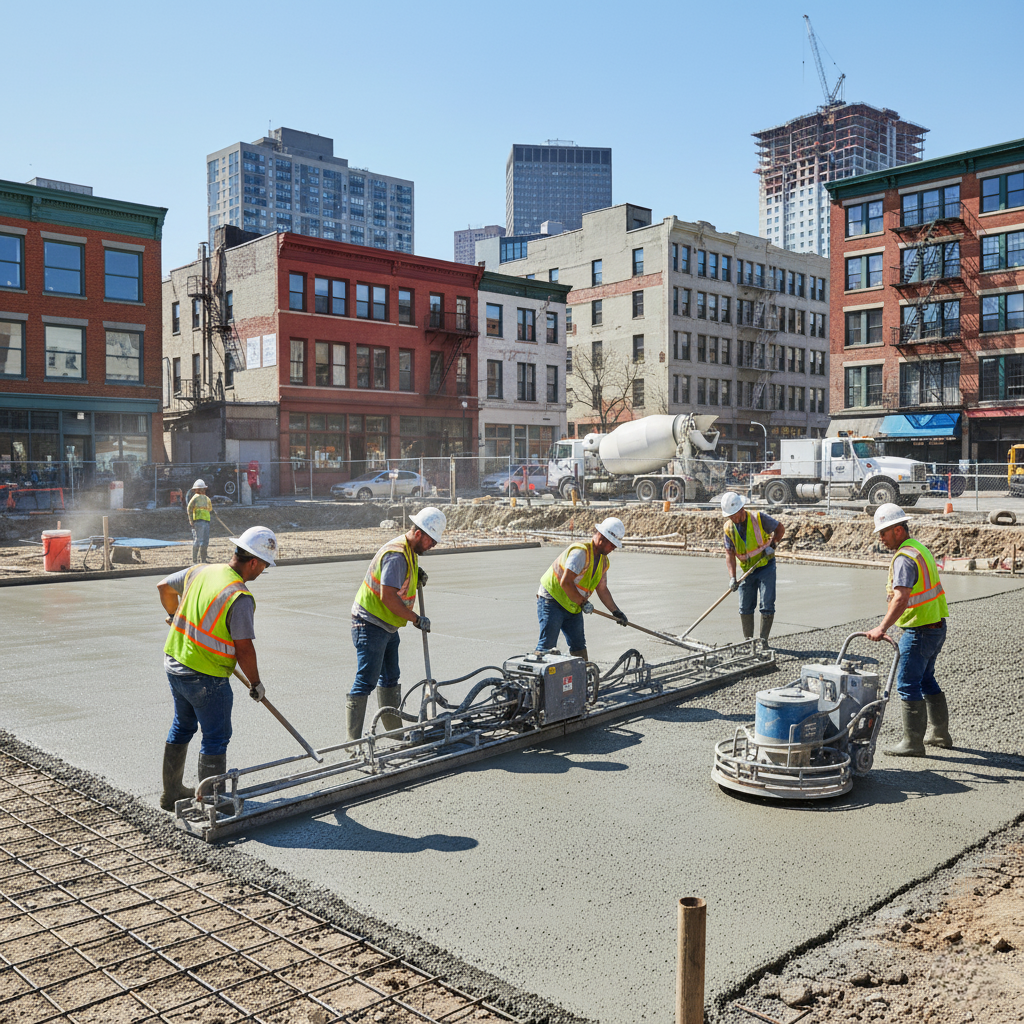
Concrete is placed systematically to eliminate segregation and ensure uniform density throughout the slab. Laser-guided equipment and mechanical screeds are used to measure and achieve the project-specified elevations and surface smoothness. Proper internal vibration of the concrete eliminates voids and ensures that the concrete surrounding the reinforcement is fully compacted.
The surface of the concrete is finished to produce the desired texture and appearance, while meeting the project-specified tolerances for flatness and levelness. Smooth, hard surfaces are typically required for commercial applications to provide a safe working environment and to resist wear and tear. Professional finishers use power trowels and specialized tools to produce consistently high-quality surfaces.
Initial float finishing is used to bring the cream to the surface of the concrete and to prepare the surface for the final finishing operation. Float finishing allows for the efficient and uniform coverage of large areas of the slab. Multiple float passes, using progressively finer blades, produce a smooth surface that is acceptable for commercial applications.
Troweling is the final finishing operation that produces the desired surface texture and meets the project-specified tolerances for smoothness. Finishers must carefully time their troweling operations to coincide with the setting characteristics of the concrete to avoid surface imperfections such as blisters and delamination. Additional troweling passes produce smoother surfaces that are suitable for the specific commercial applications.
Control joints are cut or formed into the concrete to control the location of cracks, thereby allowing the concrete to move freely without causing damage to the slab. Control joints are typically spaced at predetermined intervals based on the slab thickness and aggregate characteristics. Isolation joints are used to isolate the slabs from columns, walls, and other structural members.
Surface Tolerances and Quality Standards
Commercial concrete flatwork must meet the specified tolerance for surface flatness and levelness, which depends on the intended use of the slab. For example, warehouse floors typically have different tolerances than office space or retail areas. Professional contractors use precision instruments to verify that the surfaces meet the project specifications and industry standards, such as ACI 117.
Curing and Protection
Proper curing of the concrete will ensure that it develops the design strength and durability by maintaining a sufficient amount of moisture and temperature during the hydration process. Commercial projects often have tight construction schedules that require careful curing to achieve early strength while still developing long-term performance. Professional contractors have knowledge of various curing processes and will select the best method to apply to each project.
Wet Curing
Wet curing involves keeping the concrete surface continuously moist for a predetermined period of time, typically a minimum of seven days for standard applications. Ponding, continuous spraying, or wet burlap covering are examples of how to keep the surface moist. Wet curing will provide the best results in terms of strength development and surface quality.
Membrane Curing
Liquid membrane-forming compounds can be applied to the surface of the concrete to form a protective barrier that prevents moisture loss. Membrane curing can be beneficial for large areas where wet curing may not be practical. The contractor must ensure that the membrane curing compound is compatible with any surface treatments or coatings that will be applied to the surface.
Steam Curing
Steam curing can be used to accelerate strength development for projects that require rapid construction schedules. Steam curing requires controlled temperature and humidity to simulate the optimal conditions for cement hydration and reduce the time required to reach the specified strengths. Steam curing requires specialized equipment and trained operators to prevent thermal shock damage.
Protecting the Concrete Surface
During the curing process, the surface of the concrete must be protected from damage that may be caused by construction traffic, weather conditions, and other potential hazards. Protective coverings can be applied to the surface to prevent damage from rain, freezing temperatures, extreme heat, and other factors that may compromise the quality of the concrete. Restricting access to the slab will prevent the premature loading of the concrete that may cause permanent damage.
Monitoring Temperature
Monitoring the temperature of the concrete during the curing process is essential to ensure that the concrete remains in a state that will allow it to develop the required strength. Data loggers are used to monitor the temperature of the concrete, and the contractor must adjust the protection methods as required. Maintaining accurate records of the temperature will provide evidence of proper curing procedures and will support quality assurance and warranty purposes.
Seasonal Adjustments
Due to the variable climate found in Union City, adjustments to curing procedures must be made based on the season. In the winter months, protecting the concrete from freezing temperatures is essential to prevent damage during the early stages of strength development. In the summer months, preventing the rapid loss of moisture and subsequent thermal cracking is essential to maintaining the quality of the concrete.
Quality Assurance and Testing Protocols
Commercial concrete flatwork must meet all of the performance requirements and specifications established for the project. Comprehensive quality assurance programs are developed to ensure that the concrete meets all of the requirements. Testing protocols must be followed to verify the quality of the concrete from the initial mix design until the final strength is achieved. The contractor must maintain accurate records of all testing results to demonstrate compliance with the project requirements and industry standards.
Pre-Construction Testing
Pre-construction testing is conducted to validate the performance of the mix design and establish the baseline performance characteristics of the concrete. Laboratory testing is conducted to determine the compressive strength development, durability characteristics, and workability of the concrete. Testing before the start of the project will identify potential issues with the mix design and provide the necessary information to support specification compliance documentation.
Field Testing
Field testing is conducted during the construction phase to monitor the quality of the concrete and the placement procedures. Standard tests include slump tests to measure the consistency and workability of the concrete, air content tests to measure the amount of air entrained in the concrete, and compressive strength specimens to measure the strength development of the concrete. The frequency of testing must be determined based on the project specifications and industry standards to ensure that the results are statistically valid.
Surface Testing
Surface testing is conducted to evaluate the quality of the surface of the concrete after the placement of the concrete. Precision instruments are used to evaluate the flatness, levelness, and other quality parameters of the surface. Non-destructive testing methods can be used to evaluate the quality of the concrete without damaging the finished surface.
Documentation Requirements
Accurate records must be maintained by the contractor of all testing activities, material certifications, and quality control measures. These records will be required to support warranty claims, future maintenance planning, and regulatory compliance. Upon completion of the project, the contractor must provide a complete package of documentation to the owner.
Third-Party Inspection Services
Third-party inspection services may be required for large commercial projects or as a requirement of the building code. Third-party inspection services will provide independent verification of the quality control procedures and compliance with the project specifications and industry standards. Third-party inspection services will add credibility to the quality documentation and may be required.
Performance Monitoring and Maintenance Planning
Monitoring long-term performance will aid in identifying maintenance needs prior to becoming a major problem. Professional contractors will provide recommendations for inspection schedules, maintenance procedures, and performance expectations. Proactive maintenance provides for maximum service life and protects the investment in real estate.
Specialized Applications and Advanced Techniques
Union City has an assortment of commercial uses that necessitate specialized applications of concrete beyond typical flatwork. The application demands specialized techniques and knowledge of the specific requirements of each use to ensure the required performance characteristics are achieved by professional contractors.
Industrial floor applications, such as warehouse and manufacturing facility floors, require increased durability and load-bearing capability. Oftentimes, industrial flooring applications call for high-strength concrete with specialized reinforcement and surface treatment. The proper design of joints is crucial in both supporting the heavy equipment loads and preventing damage due to the operation of material handling equipment.
Retail and office applications place a priority on aesthetic appeal and comfort while also maintaining durability. These surfaces may include decorative treatments, polishing, or special coatings, which require compatible concrete mixes and finishing techniques. Preparation of the surface is important in order to successfully apply the decorative treatments.
Healthcare and food service establishments require surfaces that meet very stringent sanitation and safety requirements. Concrete mixes and finishing techniques must be capable of supporting the required cleaning procedures and provide slip-resistant surfaces. Specialized sealers or coatings may be used to prevent contamination and simplify maintenance.
Parking garages require concrete that can withstand the effects of salt, freeze/thaw cycles, and extreme traffic usage. Increased reinforcement, special mix designs, and protective treatments assist in achieving the desired service life in these harsh environments. Designing proper drainage prevents water from accumulating and accelerating degradation.
Loading docks and truck courts experience extremely concentrated loads, which necessitate thick concrete sections and heavy reinforcement. These areas frequently require special aggregates and high-strength concrete to support the impacts resulting from trucks and the abrasion caused by vehicle tires. Design of joints must allow for the heavy traffic while maintaining the structural integrity of the slab.
Commercial Concrete Flatwork Must Integrate With Other Building Elements
Commercial concrete flatwork must function as one cohesive system with the mechanical and plumbing systems of a structure, as well as with other construction elements. Professional contractor coordination is important to ensure that there is no conflict between the placement of the concrete and the installation of the other construction elements.
Planning and Coordinating a Commercial Concrete Project
Professional project management and planning are key to ensuring that commercial concrete projects are completed on time and within budget. Professional project managers coordinate the resources of the contractor and the owner to efficiently utilize resources while ensuring that quality standards are maintained and schedules are met.
Coordination of schedules among the contractor, owner, and other trade contractors places the concrete placement at the correct point in the project timeline to avoid conflicts with structural work, plumbing and electrical installations, and other critical path activities. Weather conditions can greatly affect scheduling and may require contingency planning.
Providing sufficient resources for a project is important for timely completion. Contractors establish and maintain working relationships with dependable suppliers and subcontractors who can meet the requirements of a project. Back-up plans are developed for unforeseen events that could disrupt the schedule.
Quality control checks performed during the course of a project provide evidence of compliance with specifications and provide an opportunity to detect problems early. Continuous inspections and testing provide ongoing information regarding the status and quality of the project.
Establishment of communication protocols among all stakeholders provides information regarding project progress, schedule changes, and quality issues. Periodic meetings provide opportunities for coordination and resolution of problems. Documentation of decisions and changes prevents misunderstandings that could negatively affect project success.
At Union City Concrete Works, we specialize in providing superior commercial concrete flatwork that satisfies the exacting requirements of Union City’s business community. We are experienced in local code and environmental conditions essential for successful commercial projects. Combining our experience with state-of-the-art technology and quality materials, we consistently produce high-quality flatwork installations that provide decades of dependable service and increase the value of properties throughout Hudson County.